The Role of Accumulators and Reservoirs in Aerospace Cooling Systems
In aerospace vehicles, thermal management is a critical challenge. Liquid cooling is often used as an alternative to simple air cooling. Liquid cooling allows for more efficient removal of heat from airborne electronics, avionics, and other specialty aerospace heat loads, but liquid cooling comes with additional challenges.
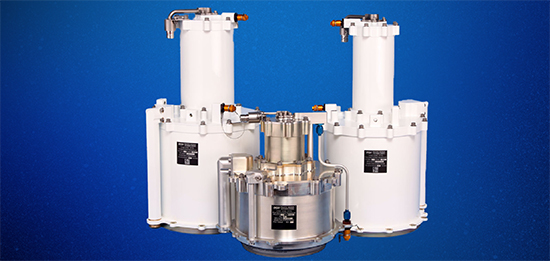
Within liquid cooling loops, accumulators serve two primary critical functions. One is to accommodate the volumetric thermal expansion of the liquid in a closed loop. The second is to provide necessary inlet pressure to the pump to be able to operate optimally and without cavitation or performance degradation.
Why Accumulators are Used
There are many liquid cooling systems in non-aerospace industries that utilize a vented reservoir or overflow reservoir instead of an accumulator. A great example of this is in a car radiator/overflow reservoir. When the coolant in the car engine gets hot and thermally expands enough to overcome the relief valve on the radiator cap, the fluid dumps into a vented overflow reservoir. These systems work great for ground-based applications, but for airborne, and especially military airborne, applications, a closed loop liquid cooling system is more reliable, resilient to harsher ambient and operating conditions, and requires less maintenance than an open/semi-open system.
A closed loop liquid cooling system is just that, a system that does not have any direct contact between the working fluid and the ambient air. The entire liquid loop would have nowhere to expand if it were not for the accumulator
Design Considerations for Accumulators in Liquid Cooling Systems
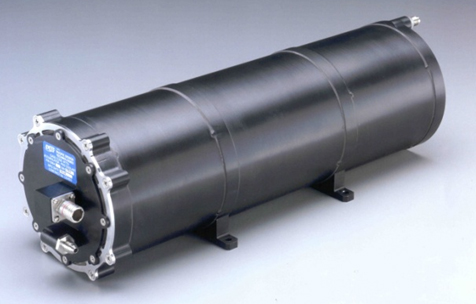
When designing a liquid cooling system, the primary factors which affect the accumulator design can be summarized by the following:
- Working fluid definition
- Total system volume
- Minimum and maximum temperature range (operating or non-operating)
- Pump minimum inlet pressure required
With these questions answered, the accumulator manufacturer can appropriately select or design an accumulator which will be functionally successful within the system. Liquids typically have a relatively linear relationship between density and temperature, and this typically results in a fixed relationship within the accumulator between temperature and %fill. Leveraging this relationship is what allows the accumulator volume to accurately represent the system fluid temperature as well so long as all purge and fill maintenance procedures are followed.

Accumulator and its Relationship with Pumps
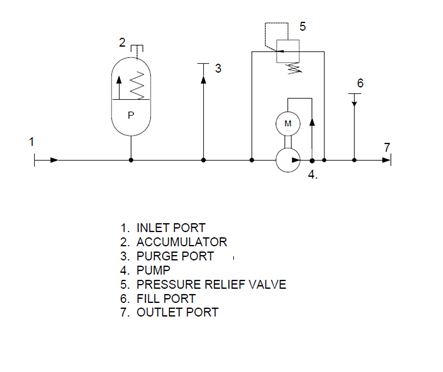
The accumulator is typically not a “flow through” device and is often placed using a tee into the main flow of the liquid cooling system at the pump inlet. A smaller tube/pipe/hose size can be used to connect the accumulator to the main system because the flow rate into and out of the accumulator is solely based on the rate of thermal expansion of the working fluid which is typically slow. The accumulator will provide a pressure reference for the pump at the pump inlet to make sure that the inlet pressure of the pump does not drop below its net positive suction head required (NPSHr).
There are many different types of accumulators used in liquid cooling systems, but maintaining an inlet pressure on the pump is a key attribute which all of them share.
Longevity and Reliability
Accumulators are typically designed to last the lifetime of the system with no maintenance. Unlike a simple component that can be easily swapped, many accumulators end up in inaccessible locations, such as deep inside an aircraft’s fuselage or on a spacecraft.
Rigorous testing is performed on accumulators: vibration tests, pressure cycle tests, burst tests, and thermal cycling, to ensure the accumulator won’t be a point of failure.
A true testament to PDT’s reliability is the Mars Rover Curiosity. PDT supplied the liquid cooling aboard the craft (including multiple accumulators), which has been operating on Mars for over 13 years.