Understanding Components in a Liquid Cooling System
In aerospace applications, managing heat is a key concern. Many sensitive electronic components and systems depend on an efficient cooling system to draw heat away. The longevity of many avionics, electronics and other critical systems relies on liquid cooling systems.
A liquid cooling system is composed of several essential components working together. Each of these components play a specific role in the heat transfer process. Together, the system works to draw heat away from equipment, then transfer and disperse the heat effectively.
Pumps
Pumps circulate the coolant throughout the liquid cooling system, ensuring it passes through the heat exchangers and absorbs heat from the components. In aerospace applications, pumps must be robust, lightweight, and capable of operating reliably under high altitudes, low pressures, and variable temperatures. Pumps are especially important to the reliability of the LCS.
Centrifugal pumps are often used in aerospace cooling systems for their ability to handle high flow rates and maintain steady pressure. Positive displacement pumps are used in applications requiring precise control of the flowrate of coolant over a wide pressure range.
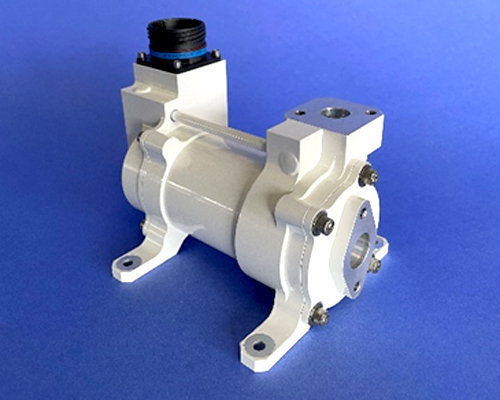
 Model 6431 Positive Displacement Coolant Pump
A
Positive Displacement coolant pump is best suited to applications where the desired flow rate is relatively low, and the pressure drop across the heat load is either high or variable. This situation often occurs in applications where loads are arranged in series, or where the loads have a high internal resistance, such as tightly packaged heat exchangers. By design, the Positive Displacement pump provides a consistent flow rate over a large range of differential pressures, which eliminates the need for active flow control devices.
 Model 5714 Centrifugal Coolant Pump
One application typical for a
Centrifugal coolant pump is to provide coolant to several heat loads installed in parallel circuits. The Centrifugal pump is often a good choice for this arrangement as a single pump can efficiently provide a high flow of coolant, compared to multiple smaller pumps feeding each heat load. By consolidating the system into a single larger pump, the overall weight, space claim, and power consumption is minimized.
Coolant
Coolant is the medium that carries heat from the system’s components to the heat exchanger. The coolant type is selected based on its thermal conductivity, specific heat capacity, and operating temperature range, all specific to each application. Coolants must be stable under extreme conditions and offer high thermal efficiency to properly cool an aerospace application.
Water-Glycol Mixtures: These are typically used for their excellent thermal properties and low freezing points, preventing the coolant from solidifying in cold environments such as high-altitudes or space.
Dielectric Fluids: These non-conductive fluids are used to cool sensitive electronics directly, as they will not damage sensitive or high-power electronics. Several oils and specialized synthetic fluids are available in the marketplace.
Accumulators & Reservoirs
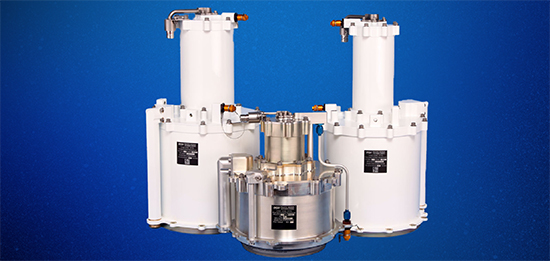
Reservoirs or Accumulators are used to store excess coolant and maintain the operating pressure of the liquid cooling system within a safe range. They allow for thermal expansion of the coolant and provide a means to regulate pump inlet pressure for maximum reliability and performance. Reservoirs are designed to be lightweight and sealed to prevent fluid loss in low-pressure environments in a variety of conditions.
Thermal Control Valves
Thermal control valves regulate coolant temperature at specific points in a system, maintaining it at a predefined level. PDT manufactures passive, thermostatic valves that function without the need for electrical power or control circuits. These valves feature a high-output linear actuator, which moves a sliding spool or poppet element. The movement of this element allows fluid passages within the valve to open or close selectively for precise temperature control. The design of the thermal control valve allows it to be used in mixing applications, as well as diverting, making them a flexible piece of equipment within the system.
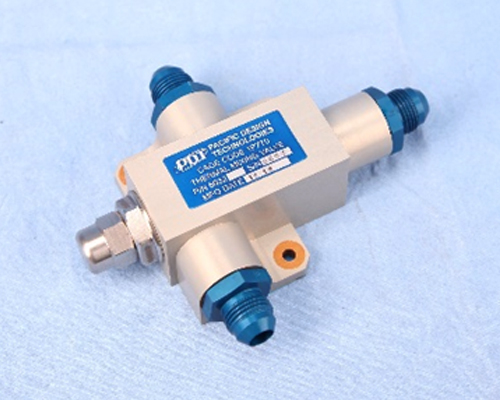 A Thermal Control Valve
Heat Exchangers
A heat exchangers primary function is to transfer heat from the source to the liquid coolant. With other aerospace components, the heat exchanger aboard an aerospace vehicle must be lightweight and efficient. Typically, our systems use a plate-pin heat exchanger due to their compact size.
PDT’s Liquid Cooling Expertise
AMETEK PDT has an extensive history of providing reliable liquid cooling systems in the commercial aerospace, defense and space industries. PDT has crafted liquid cooling solutions for several space vehicles, including the Mars Rovers. We also provide liquid cooling on board major commercial airline planes, as well as several defense applications.
If you are interested in learning more about how PDT can help keep your system cool, contact our team by filling out the form below.